Search This Blog

Showing posts with label Medical tests. Show all posts

11.06.2013

What You Need to Know About Prostate Cancer

It's MoVember or No-Shave November and I've shaved off my beard to grow it back during this month to raise awareness -- and cash -- for men's health issues.

Seems like a good time to give the Red Triage treatment to some of these health issues.

So here goes our first What You Need 2 Know (WUN2K?)

How Do You Say It? It is pronounced ProsTATE not prosTRATE. To be prostrate is to lay flat on the ground face first in front of someone either because you are being arrested or really, really into religion. ProsTATE is a greek word meaning protector or guardian. Which allows for this fun sentence: "The prostate, prostrated himself before his King."

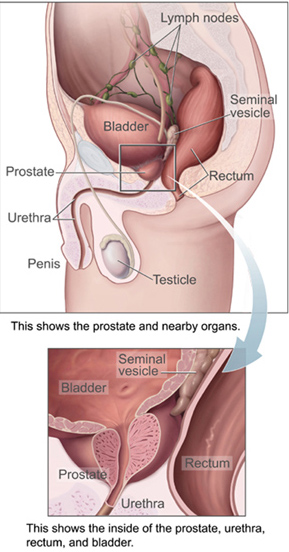
Why Do We Need It? The prostate is a gland that produces a liquid that protects the sperm from the acidic environment of the vagina.
This -- and the fact that prostate exams are conducted with a doctor's finger in the rectum -- make it hard to talk about the prostate at dinner parties.

Why It Causes Problems: This is a gland that wraps around the urethra just below the bladder. So if it swells up for any reason, it makes urinating difficult. It's not really in the penis, but messing around with it through surgery can affect a man's ability to have sex and urinate. These are two things men really like to do.

Can We Live Without It? Sure, it is one of the glands a guy could get along without. It would be harder to make babies, but not have sex. The problem comes in getting rid of it. It is located in a spot where a lot of the blood vessels and nerves running to the penis are also located. As noted above, collateral damage is possible and can lead to problems having sex and urinating.

What is Prostate Cancer? Think of cancer as runaway evolution starting with one cell that has an error in its programming. It reproduces like crazy and makes more bad copies. These cells can sometimes spread to distant parts of the body. Different cells make different kinds of cancer and those cancers cause different kinds of problems and symptoms. They act differently. Some causes big problems, pain and death. Some cause minimal problems and there are probably cancerous growths that are never discovered and are handled by our bodies defenses.

Nowhere is this more evident than in prostate cancer. There are different types - a slow growing kind and more aggressive, fast growing kinds. It has been said that most of us men - if we live long enough -- will probably die WITH prostate cancer, but not FROM prostate cancer. That's because the slow growing kind of prostate cancer is much more common. This kind does not spread to other parts of the body or mutate like the more aggressive types.

 Lies, Damn Lies and Statistics:
Prostate cancer is the most common cancer in men.
It is the second leading cause of cancer death for men in the United States.
An estimate 238,590 men will be diagnosed this year.
Approximately 29,720 will die from it.

Survival rates are good with 98 percent surviving 10 years after diagnosis and 93 percent surviving 15 years after diagnosis. However, while death from prostate cancer is declining among all men, it is still twice as high for black men than white men.  (source, American Cancer Society via Cancer.net ) Black men have a high incidence of prostate cancer and tend to get the more aggressive form. 

 Read More About Testing
Testing, Testing: This is an area where there has recently been controversy. A test for Prostate Specific Antigen has been around for years, but the test is not as specific to prostate cancer. Cancer cells in the prostate spit out large amounts of this protein, but PSA is also found in higher-than-normal levels in men other various prostate conditions, such as benign prostatic hyperplasia (BPH, an enlarged prostate) and prostatitis (inflammation or infection of the prostate). Because it is an easy test to add on to routine blood work, many men may have had this test and not even know it. 

So, if the PSA level is high, it may indicate that a man has an aggressive prostate cancer that has yet to become symptomatic.

Or it might not.

Here's what the American Society of Clinical Oncology has to say:
 In some situations, PSA testing finds aggressive prostate cancers early and save lives. However, it is not easy for a doctor to predict which tumors will grow and spread quickly and which ones will grow slowly. In some situations, men who have a prostate cancer that will never cause them harm may be discovered, and this discovery means these men will undergo additional testing and treatments that turn out to be unnecessary. These tests and treatments put a man at risk for infection, impotence, incontinence, and rarely, death. Each man’s risk of prostate cancer and acceptance of potential side effects is different.
So if you are over 50, you should talk with your doctor about whether PSA testing is appropriate and if the test comes back positive, what the plan will be. New guidelines allow doctors to take a "watch and wait" approach, rather than initiate invasive testing. (For more on this, see earlier post on Medical Testing.)

How Do I Not Get This:
Don't get old (80 percent of all prostate cancer is diagnosed after age 65) and eat a low fat diet with lots of fruits and veggies. Will that prevent prostate cancer? We don't know but it can't hurt and some research seems to point in that direction.

Don't go crazy with supplements like Selenium and Vitamin E. The SELECT study looked into these and found that they not only did not prevent prostate cancer, but may have caused more harm than good.

This seems to be a type of cancer that doesn't rely on genetic inheritance, although if you have close family members (son, brother, father) that were diagnosed at a young age, your chances are higher of developing the disease.

The Jury's Still Out: One area of research is a link between vasectomies and prostate cancer. One study in 1983 showed an increased risk, however subsequent review has shown that the link between the two is very small and the increase in risk if they are linked, is also very small. Size does matter. Get the vasectomy.

4.05.2012

Questioning Medical Tests (Demanded By Patients)

How many times have you found yourself explaining to patient why a certain tests is NOT being done. 

I do this all the time. So many patients walk in the door demanding one study or another (regardless of the cost) and are offended when they are told it is not necessary. 

Some recent examples:
1) A father who came into the Emergency Department with his daughter who had hurt her ankle when she stepped off a curb. He wanted an MRI when the Xray showed that it was likely only a sprain. 

2) A 22 year old woman who saw her PCP earlier in the day for "chest pain." She was told to take Advil, but she came to Emergency wanting and EKG, CT scan and blood work. 

3) A mother who had two daughters in a car accident. While they refused evaluation and transport on scene, the came into the ED by private vehicle. I had to explain why one patient needed a head CT while the other did not. 

As you can see, some of the these cases are indeed easier than others. 

 I often have to explain the costs, risks and benefits of certain tests to patients and patient families who insisted they were not getting good care unless ALL the possible tests were done and done RIGHT NOW. 

Indeed, we often see patients coming into the ED not because they can't get into their primary care provider for their non-emergent condition, but rather, because they saw their PCP THAT DAY and were unhappy with the result. These days patients demand tests they've heard about on TV or from friends and family and they are often disgruntled if they don't get them.

Oh, and medicaid compensation is going to be tied to patient satisfaction. Just thought I'd mention that.

This week a group nine medical societies released a list of tests that doctors should think twice about automatically ordering. You can check out the lists at Choosewisely.org

Dr. Christine Cassel, president of the American Board of Internal Medicine told MSNBC and that the idea is to reduce medical costs while doing no harm to patients. They looked at the tests that have the least benefit but that are routinely ordered per course.

"We all know there is overuse and waste in the system, so let's have the doctors take responsibility for that and look at the things that are overused," Cassel told MSNBC. "We're doing this because we think we don't need to ration health care if we get rid of waste."

Moreover, the unneeded tests often cause harm -- in radiation damage to the body, or needless suffering. Some tests can prompt doctors to take invasive procedures that cause more damage to the patient than improvement. Routine PSA tests -- as reported earlier this year -- is another example. Even the researcher that helped discover PSA says that the negative impacts of the overuse and misuse of this screening tool has lead to incontinence and impotence in many men with no decrease in cancer deaths.

"I never dreamed that my discovery four decades ago would lead to such a profit-driven public health disaster." Richard J. Ablin wrote in a New York Times Op-Ed. "The medical community must confront reality and stop the inappropriate use of P.S.A. screening. Doing so would save billions of dollars and rescue millions of men from unnecessary, debilitating treatments."

The problem has a lot to do with patient education. Patient education is hard because you are often telling someone something they don't want to hear. Often you are telling a patient with abdominal pain that we don't know what's causing it. Often you are telling the family member of a cancer patient that any further treatment is likely to cause more suffering without increasing any chance of survival. Sure some tests are ordered to shield doctors from lawsuits, but doctors also have long memories of missed diagnoses. They remember the one time they didn't order that one test and left a disease undetected. 

Will these new lists help? It certainly will lend support to providers who are trying to make the right decisions about what is best for patients based on science rather than social pressures. 

Yet patient education -- something the American healthcare system doesn't do very well right now -- is going to have to get better. 

Being a nurse is all about advocating for your patients. 

Yet, sometimes advocating for a patient means not giving them what they want. 

If You Want to Make God Laugh...

 Early on in the pandemic one of my daughters exclaimed "Covid ruins everything!"  It became a running joke in our house, a bitter...