Search This Blog

Showing posts with label Medico-history. Show all posts

2.02.2015

Things You Didn't Know About Opiates

image stolen from American Apothocary
The Atlantic has a great infographic about the history of opiates in both medical use and abuse. It is full of historical revelations including:

  • Laudanum was first formulated in the 1500s and is still available today by prescription.
  • Heroin was formulated to be a less addictive alternative to morphine.
  • Free samples of heroin were mailed out to try and help morphine addicts kick the habit. 
  • Oxycodone was created as a less addictive substitute for heroin. 
Dig a little deeper and you'll find that:
  • The whole infographic is actually advertorial created by Purdue Pharma 
  • Purdue Pharma manufactures Dilaudid, MSContin, OXYcontin and other opiates. 
What Purdue doesn't sell is Suboxone - a medication that blocks both the craving of opiate addiction and the side effects of withdrawal. With critics pointing to evidence that 12 Step programs don't work for 90 percent of addicts.  Why aren't more people using Suboxone to help kick the habit? Dying to Be Free is a long-form article on addiction and overdose that asks that question while telling the story of an addict who tried to make it on his own and failed. 

The Washington Post reports that there are limitations on prescribing Suboxone because of it's potential for abuse -- even though it is safer that Methadone on prescription pain killers. Some doctors who prescribe Suboxone think the limits are arbitrary.  

"We don't have a patient limit for anything else we do," one MD told the Washington Post. "I can prescribe oxycodone to a thousand patients." 

 A Brief History of Opiates it really is pretty interesting.
Why is Suboxone so hard to get? The Washington Post
Dying to Be Free from the HuffPo
The Cause of Addiction is Not What You Think (at least in rats) by author Johann Hari for the HuffPo


11.24.2012

Best Medical History Books


Chatting with family over the holiday always leads to the discussion of books -- at least on my part anyway. I'm always illuminating every conversation with something I've read about the history of medicine. Makes my job changing bedpans sound a lot more interesting. After all, I can't very well discuss the "what had to be removed from where" stories over turkey and stuffing.

So here is a list of books I've been recommending to the medically curious book lovers. You don't need a medical background to read and enjoy these books, just a curiosity and love of history and science.

The Emperor of All Maladies: A biography is how it is billed, but it really a history of how we treat the diseases of cancer in all their forms. Unflinching in identifying our well-intentioned mistakes and missteps, this book is enlightening, horrifying, hope-filled and magnificent. It won the Pulitzer Prize for a reason -- it is flawlessly written and masterfully researched. Probably the book I recommend above all others.

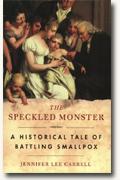
The Speckled Monster : I love reading history about people you've never heard of who changed the course of the world. In this book, Jennifer Lee Carrell creates a pulse pounding thriller on both sides of the Atlantic as medical rebels with little to go on, experiment with smallpox innoculation long before Edward Jenner noticed cow pox on the hands of milkmaids. How did Lady Mary Wortley Montagu in England and Zabdiel Boylston in colonial Boston change western history? What role did Cotton Mather and a teen-age Ben Franklin play? You have to read this amazing book to find out!

The Great Influenza There are lots of books on the Influenza pandemic -- and I've read most of them -- but John Barry's is by far the best. Not just for it's exhaustive research into the history and origins of the disease. No, Barry uses the pandemic as a focal point for the history of modern medicine, public health and medical research. Brilliant work, brilliant writing, incredibly thought provoking.

The Ghost Map: John Snow created the science of epidemiology -- and he did it by walking into a nightmare of a cholera epidemic in 1850's London. A fantastic book about one of the forgotten names of science. The author Steven Johnson also wrote "The Invention of Air" which is another of my favorite recent medico-historical books.

Germs: Biological Weapons and America's Secret War. I like this books for a lot of reasons, but mostly because it opens with the bioterror attacks of the Rajneeshee cult on the city of The Dalles in 1984. I was a 15 year old working at my mom's restaurant in The Dalles in 1984 and had a front row seat for this first documented attack of modern bioterrorism on US soil.

Stiff: Mary Roach looks into what happens to dead bodies after they are dead. Turns out there's a lot you can do with you after you are gone.

The Hot Zone - Richard Preston is why Ebola is a household word. This book is a page-turning thriller.

Deadly Feast: Richard Rhodes does for Mad Cow disease and prions what Preston did for Ebola. Well researched and unflinching scientific thriller.

The Poisoner's Handbook Long before there was CSI, forensic pathology was invented by a couple of guys in New York trying to stop an epidemic of murder by poison. Fun and fantastic reading.

The Normals: This the only novel on the list and it is for those who like their comedy dark. The down and out  protaganist signs up to the a research subject for new pharmacuticals and finds that the line between side effect and insanity is a little blurry.

I'm sure, right after I post this I'll think of a few more. Of course, I'm open to suggestions as well!

If You Want to Make God Laugh...

 Early on in the pandemic one of my daughters exclaimed "Covid ruins everything!"  It became a running joke in our house, a bitter...